Examining the process, outcomes and impacts of knowledge mobilization (KMb) initiatives from food sovereignty and climate change research in the Inuvialuit Settlement Region, Northwest Territories, Canada.
DOI:
https://doi.org/10.15353/juhr.v1i4.6738Keywords:
climate change, food sovereignty, Inuvialuit Settlement Region, knowledge mobilization, Northwest TerritoriesAbstract
Food insecurity impacts almost half of the households in the Inuvialuit Settlement Region (ISR), Northwest Territories. Climate change is making it harder to access country foods in most Arctic communities. KMb refers to the process of translating or exchanging knowledge between researchers and knowledge users. Conducting KMb in northern communities is critical to respond to these issues, but it comes with many challenges such as lack of funding, data accessibility and ownership, and the ongoing impacts of colonization. Semi-structured interviews were conducted with nine key rightsholders including researchers and community leaders to investigate the current goals, challenges and recommendations for KMb in the ISR. The transcripts were analysed for key themes in NVivo using a reflexive thematic analysis approach. This study shows that KMb in the ISR is fundamentally relationship-based and relies on strong communication and collaboration. This study provided a focused insight into what KMb looks like in the ISR, and what tools are being used to achieve effective KMb. Continuing to build community research capacity, uplifting the voices of those with lived experience, being mindful of community and research team capacity, and preemptively engaging policy decision makers are considerations for future KMb in the ISR.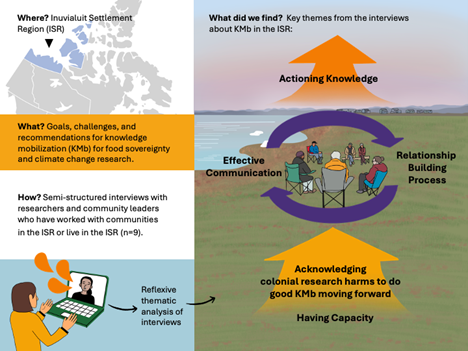
Downloads
Published
Issue
Section
License
Copyright (c) 2026 Maya Morton Ninomiya

This work is licensed under a Creative Commons Attribution 4.0 International License.